Mastering Charitable Donation Receipt Requirements: A Guide to Maximizing Your Tax Deductions

If you want to claim a tax deduction for your generosity, you’ll need more than a simple thank-you note. The IRS has very specific charitable donation receipt requirements, and that little piece of paper is your official proof. Without the right documentation, your well-intentioned gift might not count when it’s time to file, meaning you could miss out on significant tax savings.

Understanding Your Donation Receipt Essentials

Maximizing your itemized deductions starts with knowing what makes a donation receipt legitimate. Think of it as a formal record for tax purposes—one that proves your contribution. A quick email confirmation often isn’t enough; the IRS is looking for specific details to verify your gift.

Getting this right is a bigger deal than you might think. The IRS has gotten much stricter about these rules, sometimes denying deductions just because a receipt was missing a key piece of information. And with individual donors giving an incredible $319.04 billion in 2022—that’s about 64% of all charitable giving—it’s clear that proper paperwork matters for millions of taxpayers.

Core Elements of a Compliant Receipt

Every valid receipt, whether it’s for a cash gift or a bag of used clothes, has to include a few non-negotiable details. This keeps things clear for you, the charity, and the IRS.

Here’s what to look for:

  • The full name of the charitable organization.
  • The date the contribution was made.
  • A description of what you donated (e.g., the cash amount or a list of non-cash items).
  • A statement confirming whether you received anything in return for your donation.

This decision tree gives a great visual breakdown of what you need for both cash and non-cash donations.

As you can see, a formal acknowledgment from the charity is always the first step, no matter what you’re giving.

Why Every Detail Matters

Letting the details slip can put your deduction at risk if you ever face an audit. For example, if you attend a fundraising dinner where the charity provides a meal, your receipt must include a good-faith estimate of the meal’s value. You can only deduct the portion of your gift that exceeds the value of what you got back.

This is just one of many little rules that make careful record-keeping so important. To get a better handle on which of your contributions count, check out our guide on what donations are tax deductible.

Trying to keep all these details straight for dozens of donations can feel overwhelming, especially when you’re dealing with all sorts of non-cash items. This is exactly where modern tools come in to replace outdated methods. DeductAble ensures every contribution is logged with the right details from the get-go, building a solid foundation for your tax filings and helping you maximize your itemized deductions.

The Critical $250 Written Acknowledgment Rule

When it comes to charitable giving, the $250 mark is a huge deal in the eyes of the IRS. Once a single donation hits this threshold, the rules for proving your generosity get a lot stricter. A simple bank statement or a canceled check just won’t cut it anymore.

This is where you’ll run into a very specific IRS term: the “contemporaneous written acknowledgment.” It’s a bit of a mouthful, but it’s essentially the gold standard of donation receipts that a charity must provide you for any single contribution of $250 or more.

And “contemporaneous” means you need to have this document in hand before you file your taxes for the year. If you don’t, the IRS has the right to disallow your deduction, even if you can prove you made the payment.

What Must Be Included in the Acknowledgment

To be compliant, this written statement has to include several key pieces of information. It goes far beyond a simple thank-you note to paint a complete picture of your gift for the IRS.

A compliant acknowledgment must include:

  • The name of the charity.
  • The amount of cash you gave.
  • A description of any non-cash items you donated (but not their value—that’s your job to determine).
  • A clear statement confirming whether the charity gave you any goods or services in return for your donation.
  • If you did get something back, the charity has to provide a good-faith estimate of its value.

This last point is crucial. You can only deduct the portion of your contribution that exceeds the value of whatever you received. For example, if you paid $400 for a ticket to a charity dinner and the meal itself was valued at $100, your actual deductible contribution is only $300. The receipt has to spell this out clearly.

Handling Multiple Donations and Payroll Deductions

So, what happens if you make a lot of smaller gifts? It’s a common question. If you donate $50 every month to the same organization, each donation is treated on its own. Since none of them hit the $250 mark, you don’t need the special written acknowledgment for them. The rule applies to single contributions, not your total giving for the year.

Workplace giving through payroll deductions, however, has its own set of rules. The good news is you don’t need a separate receipt from the charity for every paycheck.

Instead, you can use one of these as your proof:

  • A pay stub, W-2, or another document from your employer that shows the total amount withheld for that charity.
  • A pledge card from the charity that includes a statement confirming it provides no goods or services in exchange for your payroll gifts.

For these larger donations, the date of contribution is a vital detail. While bank records often prove the date, the IRS allows the official receipt to serve as the record. This is especially important when you consider that in 2024, individuals contributed a staggering $392.45 billion of the $592.50 billion donated in the U.S. A missing date on a key receipt could be all it takes for the IRS to deny your deduction, making proper paperwork absolutely essential. You can dive deeper into these numbers with these charitable giving statistics.

How to Document Non-Cash Donations

Donating items like clothing, furniture, or household goods is a fantastic way to support causes you care about and declutter your space. But when it comes to taxes, the rules for these non-cash gifts are a lot more involved than just writing a check. You can’t just drop off a bag and hope for the best; the IRS expects you to keep detailed records.

The responsibility for valuing and documenting these items falls squarely on you, the donor. The charity’s receipt will usually just give a generic description of what you gave (think: “one bag of clothing” or “various household goods”) without assigning a dollar value. It’s your job to create a detailed inventory and figure out the Fair Market Value (FMV) for each item to back up your deduction.

Describing Your Donated Items

Vague descriptions are a red flag during an audit. Instead of jotting down “kitchen items,” you need to get specific: “four ceramic dinner plates, two coffee mugs, and one stainless steel saucepan.” That level of detail is your best defense.

For every single item, your records should include:

  • A detailed description: Be specific. “Men’s long-sleeve cotton shirt” is much better than “shirt.”
  • The item’s condition: Use clear terms like “Excellent,” “Good,” or “Fair.” This is absolutely critical for determining value.
  • The date of the donation: When did you actually hand it over to the charity?
  • The original cost (if you know it): While not always required, it provides helpful context.
  • The Fair Market Value (FMV): This is the price a willing buyer would pay for the item in its current state.

Keeping a detailed log, complete with photos, is the gold standard for creating a bulletproof record. This is exactly where manual spreadsheets become a nightmare, especially after you’ve cleared out a whole closet. It’s this tedious, time-consuming process that makes tools designed to automate documentation so incredibly useful.

Determining Fair Market Value

This is often the trickiest part. The FMV isn’t what you originally paid; it’s what that item is worth today. To be deductible at all, an item has to be in at least “good used condition or better,” unless you get a formal appraisal proving it’s worth more than $500.

For example, that designer suit you bought for $1,000 five years ago might only have an FMV of $100 today, depending on its condition and current fashion trends. You can only deduct the $100.

To figure out these values, you can research what similar items are selling for on sites like eBay or by walking through your local thrift store. But let’s be honest, that’s a lot of work. This is another area where dedicated software really shines. Many people still miss the convenience of ItsDeductible, which used to help with this. As a modern alternative, DeductAble takes the frustrating guesswork out of the equation by suggesting appropriate values based on the item and its condition.

For a deeper dive, our guide on establishing clothing donation value walks through more specific examples.

The Power of a Dedicated Tool

Trying to keep meticulous records for every single shirt, book, and piece of furniture can feel completely overwhelming. Juggling spreadsheets, phone photos, and a stack of paper receipts is a recipe for missed deductions and a massive tax-season headache. A dedicated app changes the game.

With DeductAble, you can quickly catalog each item and assign an IRS-compliant value right from your phone. When you’re done, the app generates a clean, detailed report that organizes everything for you. This creates a professional-grade record that stands up to scrutiny, filling the gap left by the now-deprecated ItsDeductible and giving you the confidence that you’ve maximized your itemized deductions correctly. This isn’t just about making things easier; it’s about accuracy and peace of mind.

Navigating IRS Form 8283 for Large Donations

Once your non-cash donations for the year climb past $500, the IRS asks for a bit more paperwork. It’s time to get familiar with Form 8283, Noncash Charitable Contributions. Think of this form not as a hassle, but as the official story you tell the IRS about the significant items you’ve generously given away.

A person organizes documents to fill out a tax form.

Filing this form isn’t optional—it’s a mandatory step to claim your deduction on these larger gifts. You’ll need to detail how you got the items, what you paid for them, and what they were worth when you donated them. At this level, solid record-keeping shifts from a good habit to an absolute necessity.

The form is broken down into two parts, Section A and Section B, and knowing which one to fill out is the first step to getting it right.

Completing Section A for Donations Under $5,000

Section A is your go-to for any single item (or a group of similar items, like a bag of designer clothes) valued between $501 and $5,000. Let’s say you donated a nice mountain bike worth $800 and a collection of vintage records valued at $1,200. Both of those would get listed here.

For each donation, you’ll need to provide:

  • A clear description of the property: Don’t just say “table.” Say “Vintage oak dining table and four chairs.”
  • The date you acquired it: An educated guess is usually fine if you don’t remember the exact day.
  • How you got it: Simple answers like “purchase,” “gift,” or “inheritance” work perfectly.
  • Your cost (or adjusted basis): This is basically what you originally paid.
  • The Fair Market Value (FMV): The amount you’re claiming for the deduction.
  • How you figured out the value: This could be a “thrift shop value guide” or “comparable sales online.”

Understanding Section B and Qualified Appraisals

When you donate something really valuable—an item or group of similar items worth more than $5,000—the rules get serious. You’ll need to tackle Section B of Form 8283, which brings a new requirement into the picture: a qualified appraisal from a qualified appraiser.

A qualified appraisal isn’t just a quick estimate from a friend. It’s a formal, detailed report prepared by a professional who meets specific IRS credentials. Skipping this step or getting it wrong can put your entire deduction at risk.

The appraiser has to physically sign your Form 8283, and the charity you donated to also needs to sign, acknowledging they received the item. It’s a paper trail that confirms both the donation and its substantial value.

You’ll almost always need an appraisal for items like:

  • Artwork or rare collectibles
  • Jewelry and antiques
  • Real estate
  • Shares of stock in a privately held company

Finding the right appraiser is on you. They must be an independent professional—not you, the charity, or the person you originally bought the item from. The appraisal itself has a strict timeline: it must be done no more than 60 days before you make the donation and no later than the due date of your tax return. Getting the appraisal right is the key to locking in those high-value deductions.

Receipt Rules for Special Donation Types

While most of our giving involves cash or a few bags of household goods, some donations just don’t fit the standard mold. These special cases come with their own unique set of rules, and understanding the specific charitable donation receipt requirements is the only way to make sure your generosity is recognized and your tax deduction is secure.

Think of it this way: the more complex or valuable the asset, the more detailed the paper trail the IRS expects. Getting this right from the start saves you from major headaches later and lets you confidently claim the full deduction you’re entitled to.

Donating a Vehicle

Giving away a car, boat, or even an airplane is a huge gesture, but figuring out your deduction isn’t as simple as checking its Blue Book value. The amount you can claim is directly tied to what the charity actually does with the vehicle after you hand over the keys.

The most important document you’ll need is Form 1098-C, Contributions of Motor Vehicles, Boats, and Airplanes. You absolutely must have this form from the charity to claim any deduction over $500.

Here’s the breakdown of how it usually works:

  • If the charity sells the vehicle: Your deduction is capped at the gross proceeds from the sale. It doesn’t matter if the Fair Market Value was $2,500; if the car sells for $1,200, that’s your maximum deduction.
  • If the charity uses the vehicle: You’re in a much better position here. If the organization puts the car to work for its mission—like using it to deliver meals—you can generally deduct its full Fair Market Value.
  • If the charity makes improvements: If the charity makes significant improvements to the vehicle before selling it, you may also be able to claim the full FMV.

Form 1098-C will spell everything out, including the final sale price if applicable. That’s the number you’ll use on your tax return. For a deeper dive, check out our complete guide on donating your car to charity.

Quid Pro Quo Contributions

Ever been to a fundraising dinner or a charity auction? If so, you’ve likely made a “quid pro quo” contribution. This is what happens when you get something in return for a donation that’s more than $75. The receipt rules are very strict here to make sure you only deduct the portion that was a true gift.

The charity is required to give you a written statement that clearly explains the value of the goods or services you received. Your deductible amount is simply the difference. For example, if you pay $200 for a gala ticket and the meal itself is valued at $80, your actual deductible donation is $120.

This good-faith estimate of value must be on your receipt. Without it, you have no way to properly calculate your deduction, and the IRS could disallow the whole thing.

Appreciated Assets and International Giving

Donating stocks or other appreciated property can be a brilliant tax-saving strategy, but it demands careful documentation. For publicly traded stocks, you’ll need a receipt from the charity or the brokerage that details the company name and the number of shares you donated.

Giving to international charities adds another layer of complexity. For any donation over $250 to a foreign charity, the IRS needs a written acknowledgment confirming the amount and that you received nothing in return. Because many international organizations don’t have U.S. 501(c)(3) status, you might need extra proof like equivalency determination letters to satisfy the IRS. This is a big deal in modern philanthropy, as Africa continues to be the most supported region for cross-border donations. You can find more insights on this from fireflygiving.com.

Trying to keep track of all these varied and complex donations is exactly where a digital tool becomes a lifesaver. Instead of juggling different forms and valuation rules in a messy spreadsheet, DeductAble lets you log each specific type of gift with the right details.

Your Digital Secret Weapon for Flawless Donation Tracking

Let’s be honest. Juggling a year’s worth of crumpled receipts, blurry phone photos, and scribbled valuation notes is a recipe for tax-time stress. That old shoebox method makes trying to meet the complex charitable donation receipt requirements feel like an impossible task.

Switching to a dedicated digital system isn’t just a nice-to-have anymore—it’s the only way to feel truly confident and accurate when you file. Think of it as your command center for giving, building an organized record of your generosity so you get every penny of the tax benefit you deserve.

A Central Hub for All Your Giving

Imagine one single, secure place where every single contribution is logged the moment you make it. That’s what happens when you move your record-keeping to a platform built for exactly this purpose. DeductAble was designed to be that central hub, bringing order to what is so often a chaotic paper trail.

A tool like this lets you:

  • Log every gift instantly: Whether it’s a check you just wrote or a bag of household goods you dropped off, you can record it right there on the spot.
  • Capture visual proof: Snapping a quick photo of your non-cash items provides undeniable proof of what you gave and what condition it was in.
  • Store digital receipts for good: Just upload a photo of your paper acknowledgment or a PDF from an email. It’s now permanently linked to that donation record, safe and sound.

This simple shift turns donation tracking from a painful year-end scramble into an easy, ongoing habit.

From Clutter to a Perfect Report

The real magic happens when it’s time to do your taxes. Instead of spending hours digging through files and trying to piece together your giving history, a digital system does all the heavy lifting for you. This is a massive upgrade from old methods, especially for the millions who relied on ItsDeductible before it was shut down.

At the end of the year, DeductAble generates a comprehensive, itemized report that neatly summarizes all your contributions. This clean, professional document has all the details your tax preparer needs, saving them—and you—a ton of time and hassle.

This isn’t just about making life easier. It’s about making sure every single donation, no matter how small, is properly accounted for with the right documentation. When your records are organized, detailed, and instantly accessible, you can file your taxes with the kind of peace of mind that only comes from knowing your deductions are 100% supported and maximized. It’s simply the smarter way to manage your giving.

Answering Your Donation Receipt Questions

Even when you know the basic rules for charitable donations, real-world giving can throw you a curveball. Getting clear answers to those “what if” scenarios is the key to making sure your generosity is properly documented and your deductions are secure.

Let’s walk through some of the most common questions donors run into.

Think of this as your go-to resource for those sticky situations. Getting these details right can save you a ton of time and prevent costly mistakes when it’s time to file.

What If a Charity Does Not Send a Receipt?

This one comes up a lot, but here’s the bottom line: the responsibility for proof ultimately falls on you, the donor. For a smaller cash gift under $250, a bank record like a canceled check or a credit card statement will usually do the trick.

But the game changes for any single contribution of $250 or more. For those, a formal written acknowledgment from the charity isn’t just nice to have—it’s mandatory. Without that specific document, the IRS can flat-out disallow your deduction. If you haven’t received one, you need to proactively contact the charity and request it before you file your taxes.

Can I Use One Receipt for Recurring Donations?

Yes, and thankfully, this is a common and perfectly acceptable practice. If you make regular monthly or quarterly donations to the same organization, they don’t have to bombard you with a separate receipt after every single payment.

Instead, the charity can send you a single, consolidated statement at the end of the year. This annual summary just needs to list the date and amount of each individual contribution and include all the other required info, like the quid pro quo statement, to be a valid IRS acknowledgment.

This consolidated approach is a lifesaver for record-keeping, both for you and the charity. It gives you one clean document covering an entire year of giving, which is far easier to manage than a dozen separate receipts.

How Long Should I Keep Donation Records?

The standard rule of thumb for all tax documents, donation receipts included, is to keep them for at least three years from the date you filed your return. That’s the typical window the IRS has to initiate an audit.

However, most financial advisors will tell you to play it safe and hold onto those records for up to seven years. This covers you in more complex financial situations where the look-back period might be longer.


Ready to stop worrying about lost receipts and missed deductions? DeductAble organizes your giving, captures every detail, and builds a perfect report for tax time. Download the app today and see how easy donation tracking can be.

What Donations Are Tax Deductible? A Complete Guide

Generosity feels good, and with a little planning, it can be a smart move at tax time, too. To maximize your tax benefit, it’s crucial to understand what donations are tax deductible. Generally, you can deduct gifts of cash, property (like that old couch or a bag of clothes), and even out-of-pocket expenses you incur while volunteering. The key is making sure your gift goes to a qualified organization—and that you have the paperwork to prove it.

Your Guide to Charitable Tax Deductions

Giving back is a powerful act, and it’s a global priority. In 2024, nearly 64% of the world’s population donated money to a good cause, demonstrating a worldwide commitment to philanthropy. In countries like the USA, Canada, and Australia, tax incentives are a significant motivator for this generosity. You can discover more insights about global giving patterns on Philanthropy.org.au.

To get that tax break, your donation must go to what the IRS calls a qualified charitable organization. Think of these as the IRS’s “approved partners” for tax-deductible giving. Most of these groups have a 501(c)(3) status, which includes places like:

  • Churches, synagogues, temples, and mosques
  • Non-profit schools and hospitals
  • Public charities focused on science, education, or preventing cruelty to animals
  • Certain veterans’ organizations

This guide will walk you through exactly what you need to know to make your generosity count and maximize your itemized deductions.

Itemizing vs. The Standard Deduction

Before we dive in, there’s a critical choice you have to make on your tax return: itemizing or taking the standard deduction. A charitable donation is an itemized deduction. This means you only get to write it off if you choose to list out all your individual deductions (like mortgage interest, state taxes, and charitable gifts) instead of taking the government’s flat-rate standard deduction.

The rule of thumb is simple: You can only deduct charitable donations if the total of all your itemized deductions is greater than the standard deduction for your filing status.

This is the first hurdle. If your itemized deductions add up to more than the standard amount, then tracking every single contribution becomes a game-changer. For many, the real challenge isn’t giving—it’s the meticulous record-keeping needed to turn that kindness into a well-deserved tax benefit. This is especially true for non-cash items, where every bag of clothes or box of books adds up. That’s precisely why the DeductAble app was created—to make sure no good deed goes uncounted and every potential deduction is captured.

Identifying Qualified Charitable Organizations

Here’s the single most important rule when it comes to charitable tax deductions: your donation must go to a qualified charitable organization. This isn’t just a suggestion; it’s an official IRS designation that confirms the group serves a public good.

Think of it like this: just because an act is generous doesn’t automatically make it a tax write-off. You can’t pay your neighbor to mow your lawn and deduct it as a business expense, and similarly, you can’t give money to just any person or cause and claim it as a charitable gift. The organization has to be officially recognized by the IRS.

Common Types of Qualified Organizations

So, what does a “qualified” organization look like? Most of them are what we typically think of as charities, and they often fall under the 501(c)(3) section of the U.S. tax code. This is a massive category covering a huge range of groups dedicated to public service.

Here are a few of the most common examples you’ll encounter:

  • Religious Organizations: Churches, mosques, synagogues, and other faith-based groups.
  • Public Charities: Think of groups focused on education, literacy, scientific research, or preventing cruelty to animals and children.
  • Non-Profit Institutions: This includes many non-profit schools, universities, and hospitals.
  • Government Entities: Donations to federal, state, and local governments can be deductible if they’re for an exclusively public purpose, like maintaining a local park.
  • Certain Veterans’ Groups: War veterans’ organizations often qualify for tax-deductible contributions.

This is a big deal because Americans are incredibly generous. In 2024 alone, charitable giving in the U.S. hit an estimated $592.50 billion, with religious organizations receiving the largest slice of the pie. Tax policies are designed to encourage that giving, which is why it’s so important to know which recipients make your donations count on your tax return. You can see the full breakdown of U.S. giving trends from Giving USA.

How to Be Sure an Organization Qualifies

The good news is you don’t have to guess. The IRS has a free, easy-to-use tool that lets you check an organization’s status before you pull out your wallet.

It’s called the Tax Exempt Organization Search tool, and it lets you look up charities by name, location, or their Employer Identification Number (EIN). This is your best friend for confirming that an organization is eligible to receive tax-deductible gifts. It takes just a minute and can save you a huge headache later.

Pro Tip: Before you write that big check or drop off a carload of goods, take a moment to look up the organization. It’s a simple step that gives you complete peace of mind and ensures your generosity gets the recognition it deserves on your tax return.

The Ones That Don’t Make the Cut

Just as important is knowing which recipients don’t qualify. While giving to these groups might feel good, it won’t get you a tax deduction. Understanding this distinction is key to avoiding mistakes when you file.

To make it crystal clear, here’s a quick comparison of organizations that generally qualify versus those that don’t.

Qualified vs. Non-Qualified Organizations

Organization Type Generally Deductible? Examples
501(c)(3) Public Charities & Churches Yes American Red Cross, local food banks, animal shelters, your church
Individuals No Helping a friend in need, contributions to a personal GoFundMe
Political Parties/Candidates No Donations to a presidential campaign or a local political party
For-Profit Businesses No Gifting money or items to a private company or corporation
Foreign Organizations Generally No Most charities based outside the U.S. (some exceptions exist via treaty)
Lobbying Groups & Social Clubs No Organizations whose main purpose is to influence legislation, country clubs

Keeping this list in mind will help you direct your generosity where it can make a difference for both the cause and your bottom line.

Deductible Donations Beyond Cash Contributions

When you hear “tax-deductible donation,” your mind probably goes straight to writing a check or clicking a “donate now” button online. And while cash gifts are the most common way to give, they’re just one piece of the puzzle. The world of non-cash donations is vast, and it’s where many people accidentally leave significant deductions behind every year.

Non-cash donations cover everything from that bag of clothes your kids outgrew to bigger assets like a car or stocks. These items are just as valuable to charities and just as valid as deductions for you, as long as you play by the rules. The trick is knowing how to value them and what paperwork to keep.

Donating Clothing and Household Goods

This is by far the most common type of non-cash donation. Think about all those boxes of books, old kitchen gadgets, furniture, and clothing you clear out every year. Every single one of those items has a potential deduction attached to it, but you have to meet one crucial IRS guideline.

To be deductible, anything you donate must be in “good used condition or better.” This is the IRS’s way of preventing people from claiming deductions for junk that’s broken, stained, or totally unusable. The bottom line: if you wouldn’t feel good about giving it to a friend, it’s probably not in good enough shape to be a deductible donation.

Once you’ve confirmed it’s in good shape, you need to figure out its Fair Market Value (FMV). This isn’t what you paid for it; it’s what a willing buyer would pay for it today in its current state. A great way to get a feel for this is to check out prices for similar items at your local thrift store.

Key Takeaway: Every single shirt, book, or coffee maker you donate has a Fair Market Value. While a few dollars here and there might not seem like much, it can add up to a seriously substantial deduction by the end of the year. This is where tracking is everything.

Let’s be honest, manually listing every single item and then hunting down its value is a huge pain. This is exactly the problem DeductAble was built to solve. It lets you quickly log your donated items, gives you researched values, and creates a neat, organized report, making sure you get the full value for your generosity without the headache.

Valuing Larger Non-Cash Donations

Moving beyond household goods, you can also donate higher-value assets. These kinds of gifts come with more specific rules, but they can also lead to a much bigger tax benefit.

Some common examples include:

  • Vehicles: Donating a car, boat, or RV is a popular choice. The tricky part is that your deduction amount often hinges on what the charity actually does with the vehicle. If they sell it, your deduction is usually limited to what they sold it for. For a complete rundown, check out our guide on the rules for donating your car to charity.
  • Stocks and Bonds: Donating appreciated stocks—ones you’ve held for over a year that have gone up in value—can be a brilliant tax move. You can typically deduct the full fair market value on the day you donate, and you get to sidestep the capital gains tax you would have paid if you sold them.
  • Real Estate: Gifting land or property to a qualified organization can also create a massive deduction. This is a more complex donation that will always require a formal appraisal to pin down its value.

Don’t Forget Your Out-of-Pocket Expenses

This is one of the most overlooked areas of charitable giving. You can’t deduct the value of your time when you volunteer, but you can absolutely deduct the costs you paid out-of-pocket to do that good work.

This includes common expenses like:

  • Mileage: You can deduct a standard rate for every mile you drive your personal car for volunteer work. For 2024, that rate is 14 cents per mile.
  • Supplies: Think about the cost of materials you buy for a volunteer project—like paint for a community cleanup or ingredients you bought to cook a meal at a soup kitchen.
  • Uniforms: If you have to buy and maintain a specific uniform for your volunteer role that you wouldn’t wear otherwise, that’s deductible.

These little costs—a few miles here, some supplies there—can add up surprisingly fast. Keeping a running log of these expenses is the key. DeductAble makes it easy to track your mileage, so these valuable deductions don’t fall through the cracks.

Getting It Right With the IRS: Valuing and Reporting Your Donations

Knowing what you can deduct is just the first step. The real challenge for many people is proving it all to the IRS. The government has specific rules for how you value and document your generosity, but don’t think of them as a burden. Think of them as a clear roadmap to getting the deduction you deserve. Follow these guidelines, and you can be confident your goodwill gets properly recognized on your tax return.

Fair Market Value: What Your Stuff is Actually Worth

For anything other than cash, the key concept to wrap your head around is Fair Market Value (FMV). This isn’t what you paid for the item; it’s the price a willing buyer would pay for it today, in its current condition.

It’s a simple idea, but it can be tricky. That couch you bought for $1,000 five years ago? Its FMV today might only be $150. On the other hand, a designer handbag you kept in pristine condition could hold a huge chunk of its original value.

Figuring this out can feel like a guessing game, but it doesn’t have to be. For a closer look at how to price common household goods, our complete Goodwill donation value guide breaks down exactly how to approach it.

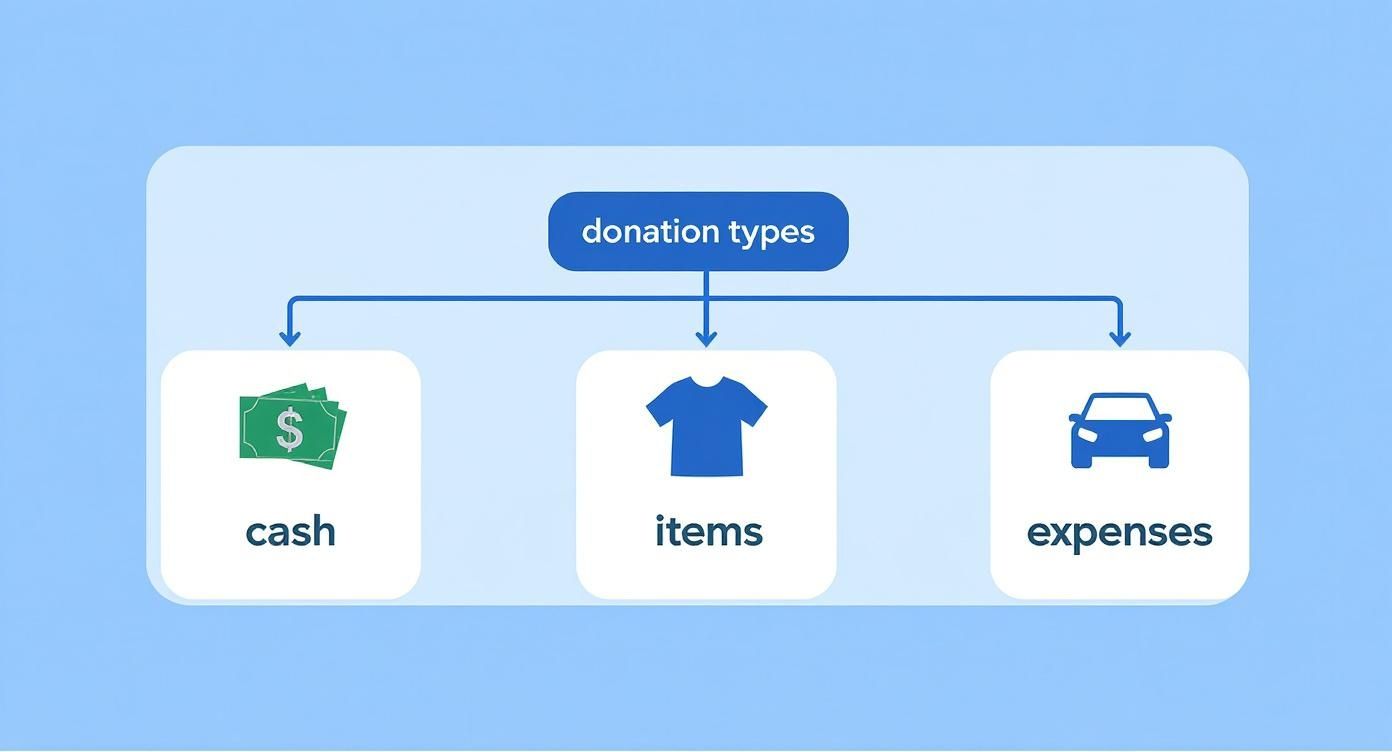
The infographic below shows the main paths your donations can take, each with its own set of rules.

Infographic decision tree showing the different types of tax-deductible donations including cash, items, and expenses.

As you can see, the proof you need changes depending on what you give and how much it’s worth.

The Paper Trail: What You Need to Keep

The IRS uses simple dollar thresholds to decide how much proof you need to provide. The more valuable your donation, the more detailed your records need to be. This is non-negotiable, and it’s where most people get tripped up.

Here’s a quick rundown of what to expect based on the value of a single donation:

  • Donations Under $250: For any gift under this amount, whether it’s cash or goods, you need to keep a reliable record. A canceled check, bank statement, or a basic receipt from the charity will do the trick. Just make sure it has the charity’s name, the date, and what you gave.
  • Donations of $250 or More: Once you hit this magic number for a single donation, your own records aren’t enough. You must get a contemporaneous written acknowledgment from the charity. This is a formal thank-you letter or receipt that spells out the donation details and, crucially, states whether you got anything in return.

That formal letter is a big deal. A simple credit card statement won’t cut it for these larger gifts.

The IRS sets clear documentation requirements based on the value of your donation. As your contributions increase, so does the level of detail needed. This table summarizes what you need to keep on hand.

IRS Donation Documentation Thresholds

Donation Value / Type Required Documentation IRS Form Needed?
Cash or Non-Cash Under $250 A bank record (canceled check, bank statement) OR a receipt from the charity with its name, date, and location. No
Single Donation of $250–$500 A contemporaneous written acknowledgment from the charity stating the donation amount and whether you received goods or services in return. No (unless total is over $500)
Total Non-Cash Donations Over $500 All of the above, plus records showing how you acquired the items and their cost basis. Yes, file Form 8283.
Single Item or Group Over $5,000 All of the above, plus a qualified written appraisal from a certified appraiser. Yes, complete Section B of Form 8283.

Keeping track of these levels is essential for a smooth tax filing experience. Good organization prevents last-minute scrambling and ensures you can back up every deduction you claim.

When Your Donations Need Their Own Tax Form

When you start donating more valuable non-cash items, the IRS wants a little more detail. This is where IRS Form 8283 comes into play.

You must file Form 8283 if your total deduction for all non-cash gifts for the year tops $500.

The form itself has different sections based on what you donated. And for the really big-ticket items, the rules get even tighter. If you donate a single item (or a group of similar items) worth more than $5,000, you’ll almost always need to get a qualified appraisal.

This isn’t just a casual estimate; it’s a formal report from a certified professional who can officially determine the item’s worth. This rule is most common for things like fine art, jewelry, antique furniture, and real estate.

Understanding Donation Limits and Carryover Rules

While your generosity might feel limitless, the IRS does put a cap on how much you can deduct each year. These rules aren’t there to discourage giving—they just keep the system fair and balanced. It all comes down to one key number on your tax return: your Adjusted Gross Income (AGI).

Think of it like this: your AGI determines the size of your “deduction bucket” for the year. You can only fill that bucket up to a certain point before your donations spill over into the next year.

The Main AGI Percentage Limits

For most donations to public charities, the limits are pretty straightforward. Knowing them helps you plan your giving so you get the maximum tax benefit each year without accidentally donating more than you can write off in a single season.

Here are the two main limits you’ll run into:

  • The 60% AGI Limit: This one is for your cash contributions. You can deduct cash gifts up to 60% of your AGI when you give to most public charities.
  • The 30% AGI Limit: This limit usually applies to non-cash donations that have gone up in value, like stocks or real estate you’ve held for over a year.

Things can get a little more complex if you donate a mix of cash and property, but these two percentages are the bedrock of the donation limits. It’s also worth noting that tax laws can shift. For instance, some significant changes are slated for 2026 that could affect giving strategies for many people. You can discover more insights about upcoming changes to charitable giving rules from Dean Dorton.

What Happens When Your Giving Exceeds the Limit?

So, what if you make a huge donation that blows past your annual AGI limit? It happens. A large, one-time gift to a university’s capital campaign or a big donation of appreciated stock could easily push you over your percentage cap for the year.

Luckily, the IRS doesn’t let that extra generosity go to waste. This is where the carryover rule becomes your best friend.

If your donations in one year exceed your AGI limit, you can “carry over” the excess amount and deduct it in future tax years. This carryover is available for up to five subsequent years.

This rule is a fantastic tool for strategic giving. It means you can make a massive impact with a large gift today, knowing you’ll be able to realize the full tax benefit over the next half-decade.

Let’s say your AGI is $100,000. That makes your cash donation limit $60,000 (60% of AGI). If you donate $75,000 in cash to your favorite nonprofit, you can deduct $60,000 this year. The remaining $15,000 isn’t lost—you simply carry it forward to deduct on next year’s tax return, as long as you’re within that year’s AGI limit.

Common Contributions That Are Not Tax Deductible

Knowing what you can deduct is powerful, but knowing what you can’t is just as important. It can save you from honest mistakes that might later turn into an IRS headache. Many well-intentioned gifts, while incredibly generous, simply don’t check the boxes the IRS requires for a charitable deduction.

Getting this right helps you focus your giving where it counts for both your community and your tax return. Let’s walk through some of the most common contributions people think are deductible, but actually aren’t.

Gifts That Don’t Qualify for a Deduction

The golden rule is pretty simple: a donation must go to a qualified 501(c)(3) organization, and you can’t get a substantial benefit in return. This one principle immediately rules out many common acts of kindness.

Here are the most frequent examples of well-meaning but non-deductible gifts:

  • Donations to Individuals: No matter how deserving someone is, you can’t deduct gifts made directly to a person or family. That includes contributing to a friend’s personal GoFundMe for medical bills or helping a neighbor after a house fire. For it to be deductible, the gift has to pass through a qualified charity first.
  • The Value of Your Time and Services: The hours you spend volunteering are priceless to the organizations you help, but the IRS won’t let you put a dollar value on them for a deduction. You can’t assign an hourly rate to your time spent sorting cans at a food bank or coaching the local little league team.
  • Political Contributions: Donations to political candidates, campaigns, or parties are never tax-deductible. This is a hard-and-fast rule that applies across the board, from local city council races all the way up to presidential campaigns.
  • Dues to Social Clubs or Fraternal Orders: Your membership payments to country clubs, lodges, or fraternal organizations don’t count as charitable contributions, even if those groups do fantastic charity work.

When You Get Something in Return

This is where things can get a little tricky. What happens when you give money to a charity and get something back, like a dinner or a t-shirt? This is what’s known as a “Quid Pro Quo” contribution, and the rule is straightforward.

You can only deduct the amount of your gift that is more than the value of the benefit you received.

For example, let’s say you pay $150 for a ticket to a charity gala. The fair market value of the dinner and entertainment is $50. In this case, you can only deduct the difference—$100.

Charities are actually required to give you a written statement that clearly breaks this down for you. The same logic applies when you buy merchandise, bid in a charity auction, or play in a fundraising golf tournament. You always have to subtract the value of what you got from your total payment.

Your Top Questions About Tax-Deductible Donations, Answered

Even after you get the hang of the basics, a few specific questions always seem to pop up when it’s time to file. Let’s tackle the most common ones so you can file with total confidence.

Can I Deduct Donations If I Take the Standard Deduction?

This is a big one. The short answer is generally no. To get a tax benefit from your charitable giving, you must itemize your deductions on Schedule A.

Think of it this way: the standard deduction is a flat, no-questions-asked amount the IRS lets you take off your income. Itemizing is when you add up all your individual deductible expenses (charity, state and local taxes, mortgage interest, etc.) to see if they beat that flat amount.

If your itemized total is higher than the standard deduction for your filing status, then itemizing is the smarter move. That’s when your donations really start to lower your tax bill.

How Do I Figure Out What My Used Clothes and Household Items Are Worth?

The IRS wants to know the item’s Fair Market Value (FMV). This isn’t what you paid for it years ago; it’s the price a stranger would realistically pay for it today, in its current condition.

A good starting point is to check out prices for similar items at your local thrift store or on sites like eBay. Some charities even publish their own valuation guides to help you out. For most people, though, this is the most tedious part of the whole process.

What’s the Deadline for Making a Deductible Donation?

To count for a specific tax year, your donation has to be made by midnight on December 31 of that year.

  • Checks: The check needs to be in the mail and postmarked by December 31.
  • Credit Cards: The charge has to actually go through by December 31.
  • Non-Cash Items: You need to physically drop off the goods by the end of the year.

The important date is when you give the donation, not when the charity cashes the check or sorts through the items.

What Records Should I Keep for My Donations?

Good record-keeping is non-negotiable if you want to claim a deduction. For any cash gift, you’ll need a bank record (like a canceled check or a credit card statement) or a formal receipt from the charity.

For items you drop off, you absolutely need a receipt from the organization that lists their name, the date, and a description of what you gave. The details on these receipts matter, which is why we have a whole guide dedicated to understanding Goodwill donation receipts.

And here’s a critical threshold: for any single donation worth $250 or more (whether cash or goods), you must have a formal written acknowledgment from the charity. This isn’t just a simple receipt; it’s a specific document that confirms the value of your gift and notes whether you got anything in return for it. Keeping all this paperwork straight is your best defense in case of an audit.


Ready to stop guessing and start getting the maximum credit for your generosity? DeductAble makes it incredibly easy to track, value, and report every single donation. Download the app and see what your giving is really worth.

Get started with DeductAble today