Maximize Your Donation: Using a Donate Car Tax Deduction Calculator

So, you’ve decided to donate your car—a fantastic way to support a cause you care about while potentially gaining a valuable tax break. But when it comes to tax time, how much can you actually deduct? It’s not always straightforward, and the answer hinges on one crucial detail: what the charity actually does with your car.

A good donate car tax deduction calculator can walk you through the specifics, but the bottom line is your deduction will be either the vehicle’s final sale price or its Fair Market Value (FMV). The IRS has clear rules that determine which value you can claim. Understanding them is the key to maximizing your itemized tax deductions and ensuring you get the full benefit you deserve.

How to Calculate Your Car Donation Tax Deduction

When you hand over the keys to your old car, you’re not just giving away a vehicle; you’re also unlocking a potential tax benefit. But the path to claiming that deduction isn’t always a straight line. The amount you can write off depends entirely on the charity’s next move.

A person holding a car key and a piggy bank, symbolizing the financial benefit of a car donation.

The rules for this got a major overhaul with the American Jobs Creation Act of 2004. Before this law, donors often claimed inflated “fair market values” that didn’t reflect reality. The new rules, which kicked in back in 2005, tied the deduction directly to the car’s actual sale price in most situations, creating a more transparent system.

The impact was immediate and massive. The number of tax returns claiming vehicle deductions plummeted by more than 65% in a single year as the stricter guidelines took hold.

Understanding Your Deduction Amount

To maximize your deduction, you first need to figure out which valuation method applies to you. The IRS rules are designed to prevent overvaluation and ensure the deduction reflects the real value the charity received. For most donors, this means your deduction is capped at the gross proceeds the charity gets from selling the car, usually at auction.

But there are a few important exceptions that let you claim the full Fair Market Value, which is often a higher number. You can claim the FMV if:

  • The charity decides to keep the vehicle and use it for its own operations (like delivering meals or transporting people).
  • The organization makes “significant material improvements” to the car before selling it.
  • The charity gives the vehicle away or sells it to a person in need for a price well below its market value.

A key takeaway here is that you absolutely must have the paperwork to back up your claim. Whether it’s the official Form 1098-C from the charity showing the sale price or a qualified appraisal for its FMV, documentation is non-negotiable.

Here’s a quick summary to help you see which rule applies to your situation.

Car Donation Deduction Scenarios at a Glance

Scenario What You Can Deduct Deduction Cap
Charity sells the car as-is The actual sale price Capped at what the car sold for
Charity uses the car for its mission The Fair Market Value (FMV) Your car’s FMV on donation date
Charity improves the car before sale The Fair Market Value (FMV) Your car’s FMV on donation date
Charity gives/sells car to the needy The Fair Market Value (FMV) Your car’s FMV on donation date

As you can see, the charity’s actions directly determine your tax benefit. This is why keeping meticulous records is so critical.

Properly documenting your non-cash contributions is the most important step in claiming the deduction you’ve earned.

Fair Market Value vs. Sale Price Explained

When you donate a vehicle, how much you can deduct on your taxes comes down to one simple question: What did the charity do with the car?

The IRS has two different paths for valuing your donation. One is based on the car’s gross sale price, and the other is based on its Fair Market Value (FMV). The path you follow isn’t up to you—it’s dictated entirely by the charity’s actions after you hand over the keys. Getting this right is the first step to using any donate car tax deduction calculator correctly.

The most common outcome is that the charity sells your car, usually at an auction. In this scenario, the rule is straightforward: your tax deduction is the exact gross proceeds from that sale. Not a penny more, not a penny less.

This amount is officially reported to you by the charity on Form 1098-C, so there’s no guesswork involved. If the car sells for $1,800, your deduction is $1,800. If it only brings in $450, your deduction is capped right there (unless it’s under $500, which has its own special rule). This keeps things simple by tying your deduction directly to the actual cash benefit the charity received.

When You Can Claim Fair Market Value

While the sale price rule is the default, there are a few key exceptions that let you claim the car’s Fair Market Value—which can often be a much higher number. This is a huge advantage, but it only applies in specific situations where the charity puts your car to work for its mission instead of just selling it for parts.

You’re allowed to deduct the FMV if the charity does one of three things:

  • Uses the vehicle in its operations. This means the charity makes significant use of the car to directly further its mission. Think of a food bank using your donated van for deliveries or a nonprofit using your old sedan to shuttle clients to appointments.
  • Makes material improvements. This is more than just a car wash and an oil change. The charity has to make substantial repairs or upgrades before selling the vehicle.
  • Gives or sells the car to a person in need. Some charities have programs where they transfer a vehicle to a low-income family for free or at a price far below market value. This directly helps someone get back on their feet.

In these cases, your donation’s value isn’t just the auction cash—it’s the real-world utility the car provided to the cause.

How to Determine Fair Market Value

So, if your donation qualifies for an FMV deduction, how do you figure out that value? The IRS has a clear definition.

Fair Market Value is the price a willing buyer would pay and a willing seller would accept for the property, when neither is forced to buy or sell and both have reasonable knowledge of the relevant facts.

For a car, this boils down to its private-party sale value. It’s not what a dealer would sell it for on their lot, and it’s definitely not the trade-in value. You need to determine what someone would realistically pay for it based on its make, model, year, mileage, and overall condition when you donated it.

To nail down an accurate FMV, turn to a trusted used car price guide like Kelley Blue Book or Edmunds. And be honest. Note the dents, the weird engine noise, and the worn-out tires. An accurate, defensible valuation is everything. The logic is similar to valuing other non-cash items, a concept we cover more broadly in our Goodwill donation value guide.

Calculating Your Deduction Step by Step

Okay, let’s get down to brass tacks. It’s one thing to know the rules, but it’s another to see how they actually play out with real numbers. Walking through the process from start to finish is the best way to understand how a donate car tax deduction calculator works and feel confident when you file.

The journey starts the second you hand over the keys, but it’s what the charity does next that really matters. The path your deduction takes depends entirely on their next move.

This visual breaks down the two main outcomes for your donation. As you can see, how the charity handles your car directly shapes your final tax deduction.
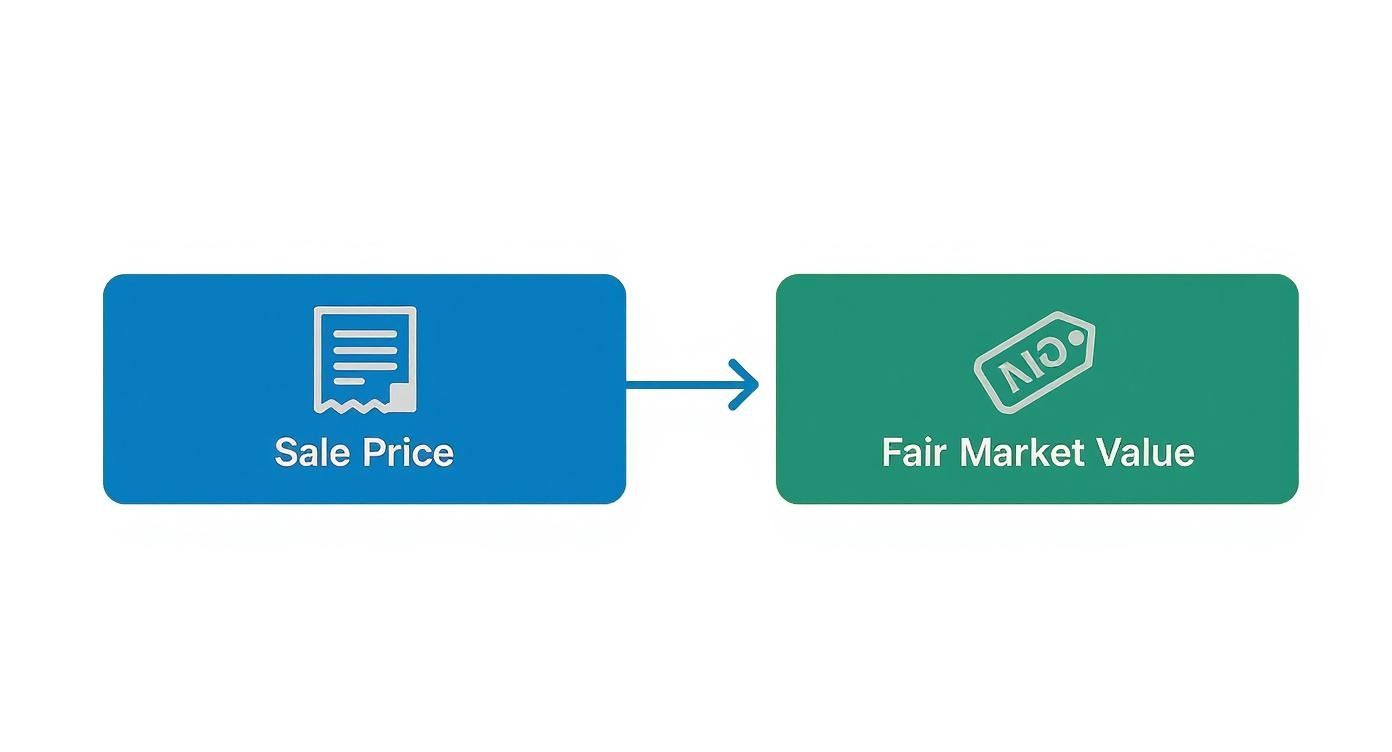
Infographic showing two paths for a car donation tax deduction: one leading to a deduction based on the car's Sale Price, a second based on its Fair Market Value.

While both scenarios begin with your generosity, the end result—your actual deduction—is determined by whether the charity sells the vehicle or puts it to work for their mission.

A Tale of Two Donations

To really see this in action, let’s imagine a donor named Alex who’s giving away a 2012 sedan. After a bit of research, Alex figures out the car’s Fair Market Value (FMV) is around $2,500. That’s a great starting point, but it’s not the final number.

What happens next is what counts. We’ll look at two possible futures for Alex’s car: one where it’s sold at auction, and another where the charity uses it in one of its programs. This side-by-side look will make it crystal clear why the rules are so important.

Scenario A: The Car Is Sold by the Charity

In our first scenario, the charity takes Alex’s sedan and sends it straight to a local auto auction. This is super common—it’s a fast, efficient way for nonprofits to turn a car into cash they can use right away.

A few weeks later, Alex gets Form 1098-C in the mail. This is the official IRS document you need, and it holds the key to your deduction. It states that the car sold for $1,200.

Because the charity sold the car as-is, Alex’s deduction is capped at that exact sale price. The initial $2,500 FMV is now completely off the table for tax purposes. The sale price is the only number that matters.

The rule is simple: if the charity sells your car, your deduction is whatever they sold it for. It doesn’t matter what you thought it was worth; the IRS only lets you claim the actual cash the charity received.

This is a critical point that trips up a lot of donors. A high FMV doesn’t mean a high deduction if the car is just flipped for cash.

Scenario B: The Car Is Used by the Charity

Now, let’s rewind and imagine a different outcome. This time, the charity that receives Alex’s car runs a program helping single mothers get to work. Instead of selling the sedan, they give it directly to a family who needs reliable transportation.

This one decision changes everything for Alex’s tax deduction. Because the charity used the car to directly advance its charitable mission, Alex is now allowed to claim the car’s full Fair Market Value.

A few weeks after donating, Alex receives a written acknowledgment from the charity. This letter confirms they won’t sell the car and are using it in their program. This piece of paper is the proof Alex needs to claim the higher FMV.

Example Calculation Walkthrough

Let’s put these two scenarios next to each other to see the real financial impact. The table below shows just how dramatically the charity’s actions can alter the tax outcome for the exact same car.

Calculation Step Scenario A: Car Sold by Charity Scenario B: Car Used by Charity
Initial FMV of Car $2,500 $2,500
Action Taken by Charity Sells the car at auction Gives the car to a family in need
Amount on Form 1098-C Gross sale price of $1,200 N/A (written acknowledgment provided)
Final Allowable Deduction $1,200 $2,500

The difference is stark. Alex’s deduction is more than double in Scenario B, all because of how the charity used the donation. This is a powerful reminder of why it pays to understand the rules before you donate and to keep flawless records of every single step.

The Essential IRS Forms and Paperwork for Your Donation

Getting your car donation paperwork right isn’t just a friendly tip from your accountant—it’s a hard-and-fast rule from the IRS. If you want to claim that deduction, you absolutely have to prove the value of your contribution with the right documents. Without them, even the most generous gift won’t stand a chance if the IRS comes knocking.

Think of your paperwork as the concrete foundation for your tax deduction. A donate car tax deduction calculator is great for a ballpark estimate, but it’s the official forms and receipts that make your claim stick. Let’s walk through exactly what you need to have in hand.

The Most Important Document: Form 1098-C

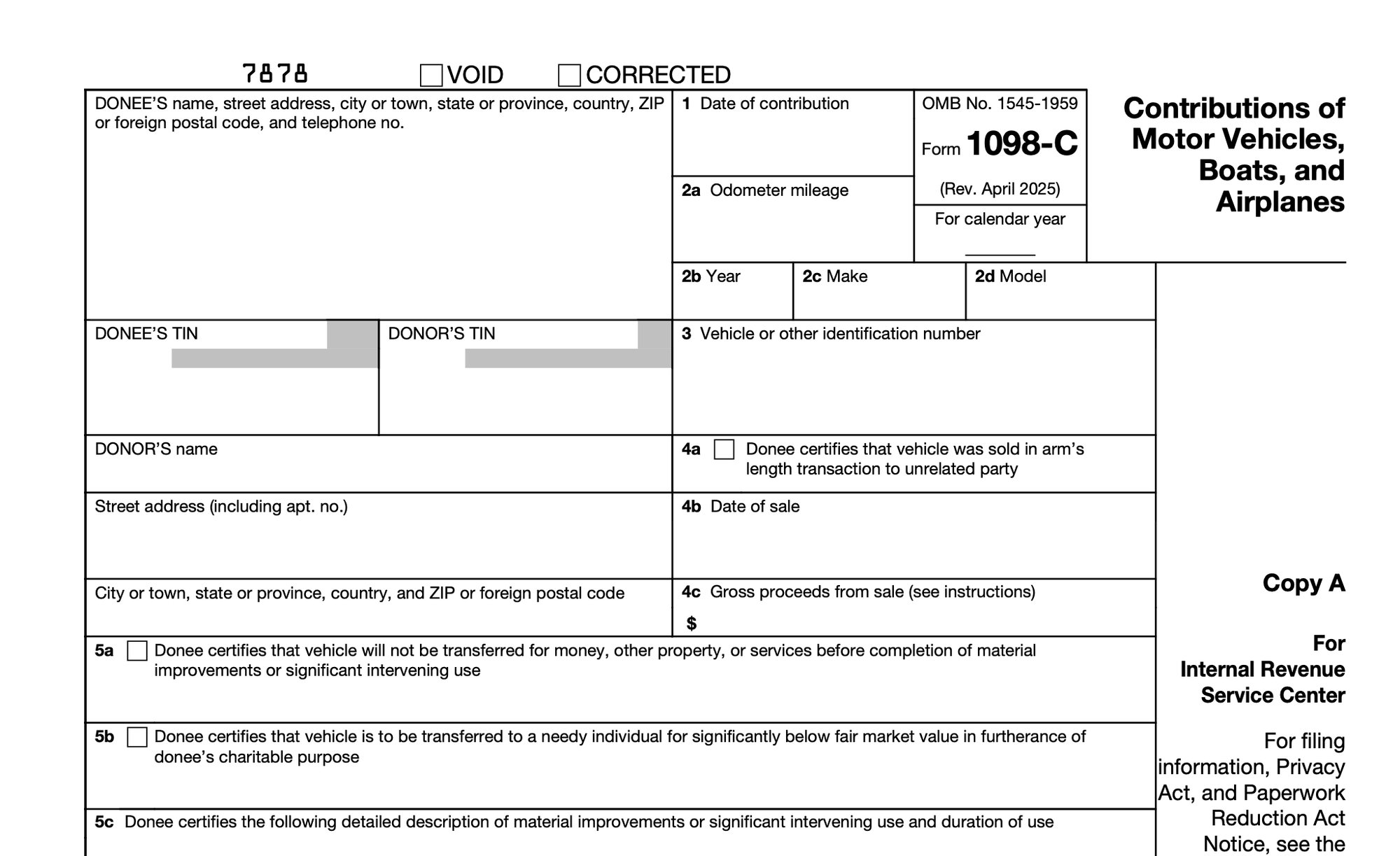
If there’s one piece of paper that matters most, it’s Form 1098-C, Contributions of Motor Vehicles, Boats, and Airplanes. This is your official receipt from the charity, and it’s what tells you the maximum amount you can deduct if they sell your car. The charity must send this to you within 30 days of the sale. Image of Form 1098-C Contributions of Motor Vehicles, Boats, and Airplanes
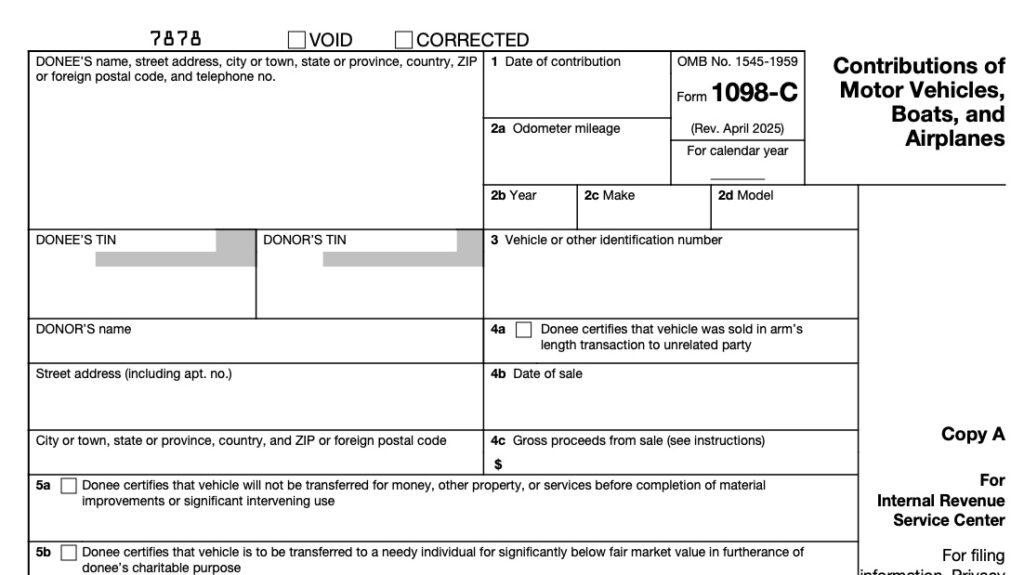
This form lays out all the critical details:

  • Your name and taxpayer ID number.
  • The vehicle identification number (VIN).
  • The date you made the contribution.
  • And the most important part: the gross proceeds the charity got from selling your car.

If the charity sells your vehicle, the number you see in Box 4c (“Gross proceeds from sale”) is your deduction limit. There’s no wiggle room here—that’s your final number.

Getting to Know Form 8283 for Noncash Donations

Things get a little more involved if your total deduction for all noncash gifts for the year (your car included) is more than $500. At that point, you’ll also need to file Form 8283, Noncash Charitable Contributions, along with your tax return. This form gives the IRS a clearer picture of what you donated.

You’ll fill out one of two sections, depending on the value of your donation.

Section A of Form 8283

You’ll use this section for noncash donations valued between $501 and $5,000. Here, you’ll list the charity’s name, describe what you gave (like a “2010 Honda Accord”), and note the donation date, how you got the car, and its fair market value.

A common trip-up is assuming you can skip this form if your car sold for over $500 but you thought its FMV was less. The IRS rule is simple: if you claim a deduction of more than $500, you have to file Form 8283.

Section B of Form 8283

This section is reserved for any single item, including a vehicle, that you value at more than $5,000. The rules get much stricter here, and you will almost certainly need a qualified written appraisal from a professional.

The charity and the appraiser both have to sign this section, certifying that everything is accurate. Trying to claim a high-value donation without a proper appraisal is one of the quickest ways to get your deduction denied. Our guide on donating your car to charity dives deeper into navigating these rules.

Why Keeping Good Records is Non-Negotiable

Beyond the official IRS forms, you need to keep your own thorough records to back up your claim. This is your first line of defense if the IRS ever has questions. Your files should be complete and organized, leaving no doubt that your deduction is legit.

Here’s what you should have in your file:

  • A copy of the vehicle title transfer showing the charity as the new owner.
  • The original Form 1098-C or a written acknowledgment from the organization.
  • A few photos of the vehicle at the time of donation to document its condition.
  • The qualified written appraisal if your deduction is over $5,000.
  • Your own notes on how you determined the Fair Market Value, if that rule applies.

Common Car Donation Mistakes to Avoid

Donating a car feels great, but a few simple missteps can turn your generous act into a major tax headache. The IRS has specific rules, and one wrong move can jeopardize your entire deduction or, worse, trigger an audit.

Think of it like this: using a donate car tax deduction calculator gets you the numbers, but avoiding these common pitfalls is what makes those numbers stick. Let’s walk through the mistakes that trip people up most often.

Overvaluing Your Vehicle

This is the big one. It’s so tempting to look up your car’s model in a price guide and pick the highest number you see, but that’s not how it works. The IRS wants the Fair Market Value (FMV), which is what a real buyer would pay for your specific car in its current condition—dents, high mileage, weird engine noise, and all.

If you claim a pristine value for a car that’s seen better days, you’re overstating your deduction. If an audit happens, that deduction could be completely disallowed, and you might even get hit with penalties. The key is to be honest and document why you valued it the way you did.

Donating to an Ineligible Organization

Here’s another trap: not all organizations that take car donations are actually “qualified” charities according to the IRS. For your donation to be deductible, it absolutely must go to a qualified 501(c)(3) organization. If you give your car to a political group, a for-profit company, or an unlisted nonprofit, you get a warm feeling but a $0 tax deduction.

Before you even think about handing over the keys, do a quick check:

  • Use the IRS Tool: Jump on the official Tax Exempt Organization Search tool on the IRS website. It’s the definitive source.
  • Ask the Charity Directly: Don’t be shy. Ask them for a copy of their IRS determination letter that proves their 501(c)(3) status.

This takes five minutes and is the single most important step to protect your deduction.

Failing to Transfer the Title Correctly

This is a surprisingly common and potentially costly mistake. If you don’t formally sign the title over to the charity, you might still be the legal owner. That means you could be on the hook for parking tickets, towing fees, or even accidents that happen long after the car has left your driveway.

A simple rule to live by: never, ever leave the “buyer” or “transferee” line on the title blank. Always write in the charity’s full, official name and make sure an authorized person from the charity signs it. This is your proof that the car is officially their problem now, not yours.

Keeping Incomplete or Messy Records

Finally, even if you do everything else right, sloppy paperwork can kill your deduction. If the IRS asks for proof and all you have is a crumpled receipt, they can deny your claim. No questions asked.

You absolutely must keep copies of the title transfer, the official Form 1098-C (or a detailed written acknowledgment) from the charity, and any appraisal documents you used.

Common Questions About Donating a Car

Even with a handy donate car tax deduction calculator, a few tricky situations always seem to pop up. Let’s walk through some of the most common questions donors ask, so you can feel completely confident in your donation.

What If My Car Sells for Less Than $500?

This is a great question, and it highlights a special rule that can actually work in your favor. If the charity sells your car for $500 or less, the IRS lets you deduct the lesser of its Fair Market Value (up to $500) or what it actually sold for.

Let’s say your car’s Fair Market Value was a solid $700, but it only fetched $350 at auction. In this case, you can claim a $500 deduction. The charity still needs to give you a written acknowledgment of the gift, but they aren’t required to send the official Form 1098-C for sales at or below this amount.

Do I Have to Itemize to Claim the Deduction?

Yes, this is non-negotiable. To claim a deduction for your donated vehicle, you absolutely must itemize your deductions on Schedule A of your Form 1040. If you take the standard deduction, you can’t claim the car donation.

Before you donate, it’s a smart move to quickly check if your total itemized deductions—your car, plus things like state taxes, mortgage interest, and other charitable gifts—will add up to more than the standard deduction for your filing status.

Can I Deduct Expenses Like Towing Fees?

Towing fees are almost never deductible because the charity handles and pays for that service nearly 100% of the time. However, you might have other out-of-pocket costs related to the donation that you can deduct.

For instance, if you paid for a professional appraisal to determine your car’s value (which is required for any claim over $5,000), that appraisal fee is considered part of your charitable contribution. It’s easy to forget these smaller expenses, but they add up.


Stop losing track of your generosity. With DeductAble, you can easily document every donation, from cars to clothes, and feel confident at tax time. Download the app and start maximizing your deductions today at https://deductable.ai.


How to Maximize Your Tax Deduction When Donating a Car to Charity

Donating your car is a fantastic way to support a cause you love, and it can come with a significant tax benefit. But the process—and the size of your deduction—pivots on one key number: $500. This figure determines whether your deduction is based on the car's Fair Market Value or what the charity actually sells it for. Understanding this rule from the start is the key to maximizing your tax savings and making your generosity count.

Your Guide to Car Donations and Maximizing Tax Savings

Turning an old car, truck, or boat into a meaningful contribution feels great. On top of that, donating your car to charity can directly lower your taxable income if you itemize. But to secure that financial benefit, you have to follow IRS rules, which can feel tricky. This guide will walk you through everything, step-by-step, so you can confidently claim the maximum deduction you're entitled to.

The process begins the moment you select a legitimate 501(c)(3) organization and doesn't end until you file your return. Your best friend through it all? Meticulous records. From the tow-truck driver's receipt to the final tax forms the charity sends, every document is a crucial piece of evidence for your deduction.

How an Itemized Deduction Works

For many donors, the tax deduction is a powerful incentive. Here's the core concept: if the charity sells your car for more than $500, you can deduct that exact sale price. If it sells for less, you can deduct its Fair Market Value, but that deduction is capped at $500. As you can see, this distinction can make a real difference in your final tax bill.

To claim this benefit, you must itemize deductions on your tax return. This is a critical point. It only makes financial sense if the total of all your itemized deductions—including your car donation, mortgage interest, state and local taxes, and other charitable gifts—exceeds the standard deduction for the tax year. You can dig deeper into how car donation tax rules may apply in 2025.

The IRS has very specific rules about how much you can deduct. I've broken down the basics in the table below.

Car Donation Tax Deduction at a Glance

This table sums up the core IRS rules based on your vehicle's final selling price.

If Your Car Sells For… Your Maximum Deduction Is… Required IRS Form from Charity
Under $500 The Fair Market Value, up to $500. A written acknowledgment (receipt).
Over $500 The exact gross sale price. Form 1098-C (or similar statement).

Remember, it's the charity's responsibility to provide you with the correct form within 30 days of the sale. If you haven't received it, follow up! This paperwork is non-negotiable proof for the IRS.

How to Choose the Right Charity and Avoid Scams

A magnifying glass held up to a document, symbolizing the process of vetting a charity.

Deciding where your old car goes is the single most important part of this process. It’s not just about picking a cause you believe in; it’s about making sure your generosity actually counts—both for the charity and for your tax return.

A great donation to a fraudulent operator can mean zero tax benefit for you. Worse, it leaves you with the sinking feeling that your goodwill was exploited.

The good news? A little due diligence goes a long way. You can feel confident you’re working with a reputable organization that aligns with your values and checks all the right boxes with the IRS. It all starts with one critical detail.

First Things First: Verify Their 501(c)(3) Status

Before you even think about handing over the keys, you must confirm the charity is a qualified 501(c)(3) organization. This is non-negotiable. Only donations to these specific, IRS-approved public charities are actually tax-deductible.

The IRS makes this surprisingly easy. Just use their online Tax Exempt Organization Search tool. Enter the charity’s name, and the database will tell you if it's in good standing. If you can’t find them, walk away. It’s a dead end for your tax deduction.

Key Takeaway: A legitimate charity will be proud of its 501(c)(3) status and won't hesitate if you ask about it. Not finding them in the official IRS database is the only red flag you need.

Look Beyond the Name and Ask the Tough Questions

Once you’ve confirmed a charity is the real deal, your next job is to figure out how they operate. Many car donation programs aren’t run by the charity itself but by a for-profit company that acts as a middleman.

While that's not automatically a bad thing, these third-party processors take a hefty cut for their services. That slice can significantly shrink the amount of money that actually makes it to the cause you want to help.

Don’t be shy about asking some direct questions:

  • "What percentage of my car's sale price actually goes to the charity's programs?" A reputable organization will be upfront about this. If they give you a vague, roundabout answer, be wary.

  • "Do you handle the process in-house, or do you use a third-party processor?" It’s good to know exactly who is managing the sale of your vehicle.

  • "Can I donate directly to you?" Sometimes, working with a local chapter of a national brand or a smaller community group means your donation has a more direct impact.

Common Scams and Red Flags to Watch For

Unfortunately, there are plenty of operators out there preying on good intentions. Knowing the warning signs can save you a world of headache and protect your donation.

Be on the lookout for these classic red flags:

  • High-Pressure Tactics: If someone is pushing you to make a decision right now, it’s a huge warning sign. A genuine charity will give you the time and space you need.

  • A Vague Mission: Trustworthy nonprofits have a clear purpose. If you can't figure out what they do or who they help after five minutes on their website, that's not a good sign.

  • Guarantees of a Big Deduction: This is a major one. Nobody can promise a specific deduction amount before your car is sold. Your write-off is based on the vehicle's actual sale price (if it’s over $500), and anyone promising otherwise is being dishonest.

Ultimately, putting in the time to research your charity is the best way to feel good about where your car is going. It’s also smart to keep notes of your research—like screenshots of the charity's 501(c)(3) status and any important emails.

Navigating the Necessary Car Donation Paperwork

A close-up of a car key and a small model car on the desk

Once you’ve found the right charity, the next step is the paperwork. This isn’t just about checking off boxes; it's about building an airtight case for your tax deduction. A single missing form or a wrongly signed title can derail the whole process, so this is where paying close attention really matters.

Think of it as telling the story of your donation to the IRS. Every receipt, form, and signature is a crucial part of that narrative. Get it right, and your generous act of donating your car to charity will be properly rewarded come tax time.

The Vehicle Title Is Your Starting Point

The single most important document is your car's title. This is the legal proof of ownership, and without it, you can't officially transfer the vehicle to the charity. It's surprising how often titles go missing, so ensure you locate yours before making the first phone call.

When it's time to sign, follow the charity's instructions precisely. Most will advise you to leave the "buyer" field blank—they’ll complete that when the car is sold. Signing in the wrong spot can void the title and cause significant issues for everyone involved.

Pro Tip: Before you sign anything, take a clear photo of the front and back of the title. This digital copy is invaluable if the original gets lost or you need to verify a detail later.

Having a digital backup of such a key document is wise. Storing these images securely alongside your other donation records keeps everything organized and accessible.

Understanding the Key IRS Forms

After your car is towed away, your focus shifts to the official tax documents the charity will send you. These forms are the backbone of your deduction claim, giving the IRS the proof and valuation it needs. Two forms, in particular, are non-negotiable.

1. Form 1098-C, Contributions of Motor Vehicles, Boats, and Airplanes
This is the big one. The charity will send this to you after your car is sold, and it's mandatory if the vehicle sells for more than $500. You must have this form before you can claim the deduction on your taxes.

The 1098-C confirms critical details, including:

  • Your name and information as the donor.

  • The vehicle identification number (VIN).

  • The date you made the donation.

  • The gross proceeds from the sale.

That last number—the gross proceeds—is almost always the exact amount you can deduct. Always double-check that the VIN on the form matches the VIN on your old registration. Any mismatch is a potential red flag for the IRS.

Here’s an example of what the IRS page for Form 1098-C looks like.

Screenshot from https://www.irs.gov/forms-pubs/about-form-1098-c

This official IRS resource is the best place to find the latest version of the form and its instructions, so you know exactly what the charity is required to provide.

2. Form 8283, Noncash Charitable Contributions
You'll need to fill out this form and attach it to your tax return if your total deduction for all noncash gifts (your car included) is over $500. For items valued between $501 and $5,000, you’ll use Section A. If your car donation is valued at more than $5,000, you’ll need to complete Section B, which also requires a formal written appraisal.

Creating an Airtight Digital Paper Trail

Physical papers have a knack for disappearing. That’s why creating a dedicated digital folder for your car donation isn't just a convenience—it's essential for protecting your deduction. The goal is to have a complete, organized record that leaves no room for doubt.

Your digital file should contain:

  • Photos of the signed title (both front and back).

  • A copy of the tow receipt you got at pickup.

  • The final Form 1098-C from the charity, saved as a PDF.

  • A filled-out copy of your Form 8283.

  • Any important emails you exchanged with the charity.

The sheer scale of car donation programs shows why solid record-keeping is so critical. These programs are huge fundraisers for nonprofits—for instance, some have raised over $175 million for organizations like Make-A-Wish. You can find more insights on modern philanthropy in reports on charitable giving in the U.S.. With so many donations happening, making sure your own paperwork is perfect is the only way to guarantee you get the deduction you deserve.

By diligently gathering and organizing these documents, you turn a potentially confusing process into a simple one. This prep work makes tax filing a breeze and gives you peace of mind, knowing your donation is fully and accurately documented.

Nailing the Valuation of Your Donated Car

https://www.youtube.com/embed/o3D2ibIcb3s

Figuring out what your donated car is actually worth for tax purposes can feel like a guessing game. But it's the most critical part of maximizing your deduction. If you get this right, you can confidently claim a significant tax benefit. If you get it wrong, you could lose the deduction entirely or even attract unwanted attention from the IRS.

The whole valuation puzzle really comes down to what the charity ends up doing with your car. More specifically, it hinges on its final sale price. The magic number that changes everything is $500. Once you get your head around this rule, the rest of the process becomes much clearer.

The All-Important $500 Rule

The IRS draws a very clear line in the sand at the $500 mark, and this threshold dictates exactly how you'll calculate your deduction. It's not a guideline—it's a hard rule you must follow when donating your car to charity.

Here’s how it breaks down:

  • If the car sells for $500 or less: You can generally claim the vehicle's Fair Market Value (FMV), but your deduction is capped at $500. So, if your car’s FMV is $800, but the charity only gets $450 at auction, your deduction is limited to $500.

  • If the car sells for more than $500: Your deduction is limited to the exact gross proceeds from the sale. No wiggle room here. If your car sells for $2,100, your deduction is precisely $2,100.

This is exactly why you must wait for the charity to sell the vehicle and send you Form 1098-C before you can finalize your tax return. That form is your golden ticket—it lists the official sale price, which becomes the number you use for your deduction.

How to Figure Out Fair Market Value

For those times when you can claim Fair Market Value (i.e., when the car sells for $500 or less), you need a solid, defensible way to determine that value. You can't just pull a number out of thin air. The IRS defines FMV as the price a willing buyer would pay a willing seller when both parties know all the relevant facts and neither is under pressure to act.

To establish a credible FMV, you need to turn to recognized resources.

Reputable Guides for Vehicle Valuation:

  • Kelley Blue Book (KBB): This is the go-to for most people. Use the "Private Party Value" and be brutally honest about your car's condition (Fair, Good, etc.) to get an accurate estimate.

  • Edmunds: Another excellent source that gives you a True Market Value (TMV) based on what similar cars have recently sold for in your area.

  • NADAguides: Often used by dealers and banks, this guide is another great data point for establishing a credible value.

Here's a real-world example: You donate a 15-year-old sedan that runs but has some visible rust. KBB puts its private party value in "Fair" condition at $950. A few weeks later, the charity sells it at auction for $400. Since the sale price was under the threshold, you can claim its FMV, but your deduction is capped at $500.

Pro tip: Always take screenshots of the valuation reports and save them with your tax records.

The Big Exceptions to the Sale Price Rule

While the sale price is usually the final word, there are a few important exceptions where you can claim the car's full Fair Market Value, even if it's way over $500. These are game-changers for maximizing your deduction.

These special cases kick in when the charity:

  1. Makes "significant intervening use" of the car: This means they actually use the vehicle in their day-to-day work, like using a donated van to deliver meals to seniors for a year.

  2. Makes "material improvements" to the car: The charity puts in significant work to repair or upgrade the vehicle before selling it.

  3. Gives or sells the car to a needy person at a deep discount: This has to be part of the charity's core mission to help the disadvantaged.

If your donation falls into one of these buckets, the charity will check a specific box on your Form 1098-C and certify it. That’s your green light to claim the full FMV, which you’ll then need to back up with a valuation guide. This can make a massive difference. A car that sells for $1,200 might have an FMV of $3,500, and this exception lets you claim that much larger amount.

Claiming and Maximizing Your Tax Deduction

A person at a desk reviewing tax documents on a laptop, with a calculator and coffee nearby.

This is where all your hard work pays off. You've chosen a reputable charity, navigated the paperwork, and are ready to claim the tax deduction you've rightfully earned. Getting from "car gone" to "taxes filed" is straightforward once you know the steps and have your documents in order.

The final stretch begins when the tow truck arrives. Before they drive off, make sure you get a copy of the tow receipt. That little piece of paper is your first official record. It's more than a formality—it's proof of the exact date you made the donation, which is critical for your tax return.

The Power of Meticulous Record-Keeping

When tax season arrives, relying on memory won't suffice with the IRS. They require evidence. Being organized becomes your greatest asset, transforming the process of donating your car to charity from a hectic search for documents into a calm, stress-free task.

Your goal is to create a comprehensive account of your donation. This involves capturing images of the car's condition just before pickup, photographing the signed title, and retaining copies of all documents. These elements form an irrefutable record of your contribution.

Key Insight: While the IRS doesn't expect you to be a tax expert, they do expect you to be organized. A complete, straightforward paper trail is your best support if any questions arise about your deduction.

Keeping an organized collection of photos and documents ensures nothing is misplaced and everything is prepared for tax time.

From Form 1098-C to Your Tax Return

Once the charity sells your vehicle, they’ll mail you Form 1098-C, Contributions of Motor Vehicles, Boats, and Airplanes. This is the single most important document in the whole process. If the car sold for more than $500, you absolutely must have this form before you file your taxes.

This form officially states the gross proceeds from the sale—and that's the exact amount you're allowed to deduct.

Here’s how you get that number onto your tax return:

  1. Grab Schedule A (Itemized Deductions): This is where you list all your itemized deductions, including charitable contributions.

  2. Enter the Donation Amount: On the "Gifts to Charity" line, write in the sale amount shown on your Form 1098-C.

  3. Attach Your Proof: You must attach a copy of Form 1098-C to your tax return. And if your total noncash donations for the year top $500, you'll also need to fill out and attach Form 8283, Noncash Charitable Contributions.

Think of it this way: Form 1098-C is the charity's official verification, and Form 8283 is your formal declaration to the IRS. You need both to complete the picture.

Building Your Evidence File for Maximum Confidence

To file your return without any last-minute panic, you need a complete evidence file. Just imagine an IRS agent asking you to prove everything—your file should have all the answers.

Your Essential Checklist:

  • Photographic Proof: Clear photos of the car from every angle, the odometer reading, and close-ups of any major dents or scratches. This backs up the vehicle's condition.

  • The Pickup Receipt: That initial receipt from the tow company confirming the donation date.

  • Title Transfer Records: A photo or scan of the signed-over vehicle title.

  • Official Charity Communications: Save any important emails or letters you received.

  • IRS Forms: Keep a digital copy of the finished Form 1098-C from the charity, plus your own completed Form 8283.

You can definitely gather all this manually, but using an app makes it a whole lot easier. You just upload each document as it comes in. When you're ready to file, you can generate a single, professional report with every piece of evidence. This simple step turns a messy task into an organized process, ensuring you can confidently claim every single dollar you deserve.

Got a Few Lingering Questions?

Even after you've picked the perfect charity and started gathering paperwork, a few "what ifs" can still pop up. That’s completely normal. Let’s walk through some of the most common questions donors have so you can move forward with total confidence.

I hear this one all the time: people hesitate because they think their car isn't "good enough" to be a worthy donation. Let's clear that up right now.

Can I Donate a Car That Doesn’t Run?

Absolutely. In fact, most charities are happy to take vehicles in any condition, whether they're pristine, have a few dings, or haven't started in years.

They have established relationships with auction houses and salvage yards that are masters at getting value out of non-running cars. They'll either sell it for parts or scrap metal, and every dollar goes toward the charity's mission. The best part? They almost always handle the towing for free, so you don't have to stress about getting it off your property. Your final tax receipt will simply reflect what the car sold for, and that's the amount you get to deduct.

What if I Can't Find My Car Title?

This is a common hiccup, but it’s an essential one. You need the title to legally transfer ownership to the charity. If you’ve misplaced it, your first stop should be your state's Department of Motor Vehicles (DMV) to request a duplicate.

My advice? Get this sorted out before you even contact a charity. It can sometimes take a few weeks to get the new title in the mail, and attempting to start the donation process without it will just lead to headaches and delays for everyone.

A Quick Pro Tip: While you're on the DMV website or at the office, look up the specific rules for transferring a title for a donation in your state. A few minutes of prep work here will save you a lot of time down the road.

Keeping a digital trail of everything is a smart move. Consider tracking the duplicate title application, photos of your car, and eventually, the tax forms from the charity. Organizing these documents securely ensures everything is ready when you sit down to do your taxes.

How Long Does This Whole Process Take, Anyway?

The first part is surprisingly quick. You can usually fill out the charity's online form or make a phone call in just a few minutes. From there, they typically schedule the pickup within one to three business days.

The waiting game comes next. It can take anywhere from a couple of weeks to over a month for the car to actually sell at auction, depending on their schedule and what the market looks like. Once the sale is a done deal, the charity has 30 days to send you Form 1098-C, your official tax receipt. Remember, you have to have that form in your hands before you can claim the deduction on your tax return.